


Cataract Surgery in Singapore

Cataract Surgery in Singapore
Cataract surgery is a safe and commonly performed eye procedure that removes the eye’s cloudy natural lens and replaces it with a clear artificial lens, helping restore sharper vision and reduce glare or haziness. In Singapore, cataract surgery is performed according to established healthcare standards, ensuring patient safety, clinical effectiveness, and appropriate post-operative care.
At Eagle Eye Centre, cataract surgery is performed by experienced ophthalmologists using modern surgical techniques and personalised intraocular lens (IOL) options, guided by a comprehensive pre-surgery assessment.
What Is Bladeless LASIK?
Bladeless LASIK is a modern laser eye surgery that corrects vision without using a blade. Instead, it uses a femtosecond laser to create a thin flap on the cornea, allowing for safer and more precise treatment.
At Eagle Eye Centre, we use advanced technologies such as the Ziemer FEMTO LDV Z6, Z8, and the Zeiss VisuMax 800. These systems provide fast, accurate results and are suitable even for patients with thin or irregular corneas.
LASIK works by reshaping the clear front part of the eye (the cornea) to improve how light focuses on the retina. The flap is gently lifted, the laser reshapes the cornea, and the flap is placed back to heal naturally; no stitches needed.
What Vision Problems Can LASIK Correct?
At Eagle Eye Centre, LASIK surgery is commonly used to correct various refractive errors that affect your vision. If you are experiencing any of these vision problems, our team of experienced ophthalmologists can assess your suitability for LASIK or other laser vision correction options. Book a consultation at Eagle Eye Centre to explore the best solution for your eyes.
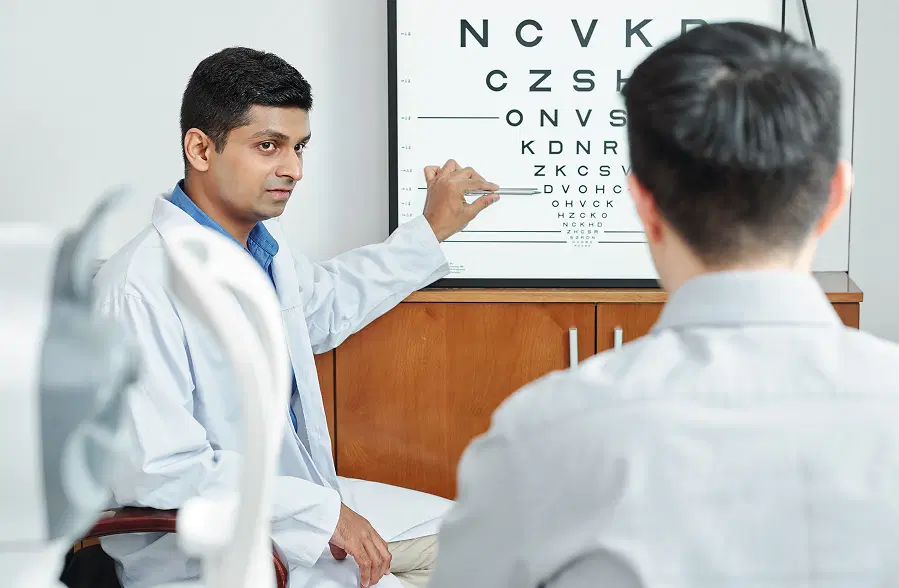
Myopia (short-sightedness)
Difficulty seeing objects at a distance, while near vision remains clear.

Hyperopia (long-sightedness)
Trouble focusing on nearby objects, especially during reading or close work.

Astigmatism
Blurred or distorted vision at all distances due to an irregularly shaped cornea.

WHAT YOU SEE MATTERS
Am I a candidate for LASIK?
You may be a suitable candidate for LASIK if you are at least 18 years old, have stable vision, do not have any active eye diseases, and have sufficient corneal thickness. If your corneas are found to be thin or borderline during your assessment, your doctor may recommend corneal strengthening with Avedro cross-linking (CXL) System to support the safety and long-term effectiveness of the procedure.
Treatment Process
-
Pre-LASIK Assessment
Eye scans, evaluation, consultation.
-
Surgery Day
Eye preparation, flap creation, laser correction.
-
Immediate Recovery
Brief rest, medication provided.
-
Follow-Up Care
Reviews on Day 1, Week 1, Month 1, and as advised.


What are your concerns?
In its early stages, a cataract may not show visible signs, but you might notice subtle changes in your vision. Some of the most common symptoms include:
- Blurred Vision
- Eye Pain
- Floaters and Flashers
- Halos and Glare
- Loss of Vision
- Foreign Body Sensation
- Red Eyes and Eyelids
- Sensitivity to Light (Photophobia)
- Twitching Eyelids
- Watery Eyes (Epiphora)
Frequently Asked Questions
Ask us anything about how we can help you understand eye care better!
Cataract surgery is Medisave-claimable in Singapore, subject to prevailing Ministry of Health (MOH) guidelines. In general, patients may claim up to $2,450 per eye from Medisave, inclusive of surgical fees, anaesthesia, and day surgery charges. The final claimable amount depends on the complexity of the surgery, whether additional procedures are required, and the available Medisave balance. Our clinic team will advise on the estimated claim during consultation and assist with documentation.
Yes. Patients may use immediate family members’ Medisave, including a spouse, parents, or children, subject to Medisave regulations and sufficient balance. Our staff can guide you through the authorisation process.
Medisave generally covers the surgical component of cataract surgery. Premium IOLs, such as multifocal, extended depth-of-focus, or toric lenses, may involve additional out-of-pocket costs. Your ophthalmologist will explain the options and associated costs during consultation.
Some patients may be able to use Integrated Shield Plans or private insurance policies. Coverage depends on individual policy terms. Our clinic team can provide the necessary medical information for insurance enquiries.
Cataract surgery is typically not painful. It is performed under local anaesthesia, usually with numbing eye drops. Mild discomfort or light sensitivity may occur for a few days after surgery and can be managed with prescribed eye drops.
The procedure usually takes 20 to 30 minutes per eye. Including preparation and recovery time, patients can expect to spend a few hours at the clinic on the day of surgery.
For safety reasons, cataract surgery is usually performed on one eye at a time, with the second eye scheduled on a separate date after assessing recovery.
Treatment Comparison Guide
Procedure
- Bladeless LASIK
- Zeiss SMILE
- Epi-LASIK
- Trans PRK / No Touch EPI-LASIK
Technology Used
- Flap technique
- Lenticule technique
- Surface laser technique
- Surface excimer laser (No touch)
Best for
- Most refractive errors
- Most refractive errors, Active lifestyles, contact sports
- Patients with thin corneas, Active lifestyles, contact sports
- Active lifestyles, contact sports, thin corneas
Recovery Time
- 1 to 2 days
- 1 to 2 days
- 5 days to 3 months
- 5 days to 3 months
Cost per Eye
- From $3,250
- From $1,940
- From $3,250
- From $1,940
Our Specialists
Our team of board-certified ophthalmologists and licensed optometrists brings together decades of specialized training and experience. Each doctor has completed additional fellowship training in subspecialty areas, ensuring you receive the most advanced care available.

Dr Julian Theng Thiam Siew
Group Chairman and Medical Director of Eagle Eye Centre
- LASIK
- EPI-LASIK
- Trans PRK

Dr Jay Siak
Director of Uveitis, Ocular Inflammation & Autoimmune Eye Disease
- LASIK
- EPI-LASIK
- Trans PRK

Dr Lynn Yeo
Director of Refractive Surgery and Comprehensive Ophthalmic Services
- LASIK
- EPI-LASIK
- Trans PRK

Dr Stephanie Young
Director of Ophthalmic Plastic & Reconstructive Surgery
- Diabetic Eye
- Cataract
- Eye Inflammation

Dr Jean Chai
senior cosultant
Director of Cornea Services, LASIK Services and Refractive Surgery
- MBBS
- MBBS
- MBBS
- LASIK
- EPI-LASIK
- Trans PRK
Recovery and Aftercare

First 24 Hours
Light sensitivity, tearing, blurry vision. Use prescribed drops.
First Week
Avoid rubbing eyes, swimming, makeup, dusty environments.
First Month
Avoid contact sports. Use sunglasses outdoors.
Ongoing Care
Attend all follow-up appointments.
Related Treatments
- Epi-LASIK
- No Touch Laser Epi-LASIK
- Bladeless LASIK
- ReLEx® SMILE